Why DFW Driveways Crack Early: PSI, Rebar and Base Prep
A North Texas driveway should last thirty years or more. Many crack within a few. Here is how concrete strength, rebar versus wire mesh, base compaction on clay and control joints decide which one you get.
Short answer
DFW driveways crack early for four main reasons: a weak concrete mix, steel that is missing or sitting at the bottom of the slab, a base that was not properly prepared and compacted over expansive clay, and control joints that were cut too late or too far apart. Build it right, with a stronger mix, rebar on chairs, a compacted base and joints cut on time, and a driveway in North Texas should last thirty years or more.
Drive through almost any neighborhood in Frisco, McKinney, Allen, Plano or Wylie and you will see driveways that are only a few years old with cracks running across them, corners that have dropped, or panels that have lifted at the joints. Some cracking in concrete is normal. Concrete shrinks as it cures, and the ground in North Texas moves. But a lot of early failure comes down to decisions made before and during the pour.
This article covers what those decisions are, so you know what to ask for when you get bids.
Concrete strength: what PSI means
Concrete strength is measured in PSI, or pounds per square inch. It is the compressive strength the mix reaches after it cures, usually tested at 28 days. The number depends mostly on how much cement is in the mix and how much water is used.
| Mix | What it is | What to expect |
|---|---|---|
| 2,500 PSI | A lower-cement mix you will still see in low bids. | Weaker surface, less resistance to cracking, scaling and wear from vehicles. |
| 3,000 PSI | A common minimum for residential driveways. | Reasonable for light vehicles when the base and steel are right. |
| 3,500 to 4,000 PSI | A stronger mix with more cement. | Better durability, surface hardness and resistance to cracking. A good choice for most DFW driveways and aprons. |
Ask every contractor which mix they are pricing. A lower PSI mix saves money on the truck ticket, and that is often where the difference between two bids is hiding.
Watch for extra water
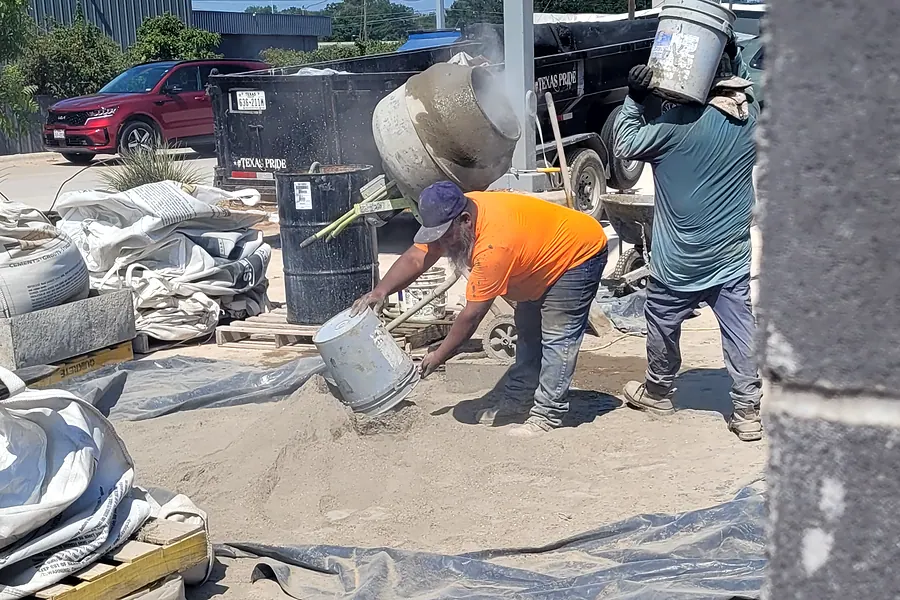
Adding water at the truck makes concrete easier to place, and it also weakens it. More water means a higher water-to-cement ratio, which lowers strength and increases shrinkage cracking. A crew that is hosing water into the chute on a hot day is trading your driveway’s life for an easier afternoon. Our article on pouring concrete in 100-degree heat covers how good crews handle workability without watering down the mix.
Rebar vs. wire mesh
Concrete is very strong in compression and weak in tension. Steel reinforcement carries the tension and holds the slab together when it cracks. There are two common options:
- Welded wire mesh: a grid of thin wire that comes in rolls or sheets. It helps control crack width. The problem is placement. Mesh is often laid on the ground and walked on during the pour, so it ends up at the bottom of the slab where it does almost nothing.
- Rebar: steel bars, typically #3 or #4, tied in a grid, commonly around 18 to 24 inches on center for driveways. Rebar is stiffer and holds the slab together better when the ground underneath moves, which matters on North Texas clay.
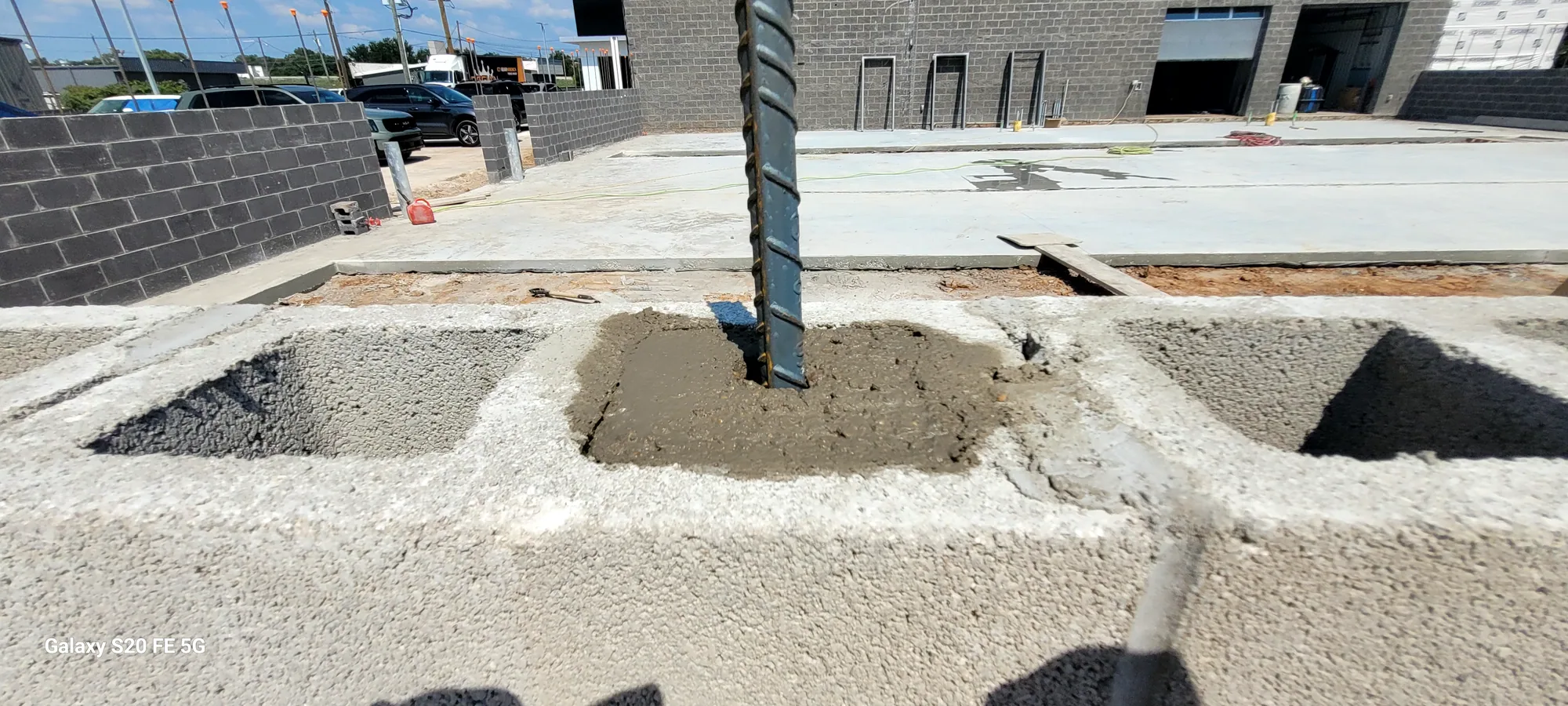
Whatever steel is used, it has to be in the right place. Rebar should sit on plastic or concrete chairs so it stays near the middle of the slab during the pour. Steel lying on the dirt is not reinforcing anything.
What to check on pour day
Before the truck arrives, look at the forms. You should see rebar tied in a grid and lifted off the ground on chairs, a compacted base and the forms set to the right thickness. If the steel is lying flat on the dirt, ask about it before the concrete goes in. After the pour it is too late.
Why base prep matters more on clay
The base is what the slab rests on. On North Texas clay, it is often the difference between a driveway that lasts and one that cracks in the first summer.
The expansive clay under much of DFW swells when wet and shrinks when dry. A slab poured straight onto loose, uncompacted clay gets uneven support: soft spots where the soil settles, high spots where it swells. The slab bends over those spots and cracks. We explain the clay cycle in detail in Why DFW Homes Crack.
Good base prep in North Texas includes:
- Removing the old slab, organic topsoil and roots down to firm subgrade.
- Grading so water drains off and away, not toward the house or into the base.
- Compacting the subgrade with a plate compactor or roller, not just leveling it with a rake.
- Placing and compacting a granular base, such as crushed stone or select fill, to give the slab uniform support.
Drainage is part of base prep. A driveway that sheds water toward the garage or holds water along one edge will keep feeding the clay under it. If your lot has drainage problems, fix those first. See Standing Water Near Your Slab?
Thickness
Four inches is the common minimum for a residential driveway carrying cars. Five to six inches is a better choice for heavier trucks, RVs, trailers and the apron where the driveway meets the street, where loads and stress are highest. Thicker concrete is stronger and stiffer. Ask for the thickness in writing.
Control joints: cut on time, in the right place
Concrete will crack as it shrinks. Control joints decide where. A joint is a groove cut or tooled into the slab to create a weak line, so the crack forms neatly inside the joint instead of wandering across the panel.
- Depth: about one quarter of the slab thickness. For a 4-inch slab, that is about 1 inch deep.
- Spacing: a common rule of thumb is two to three times the slab thickness in feet. A 4-inch slab gets joints roughly every 8 to 12 feet.
- Shape: panels should be as close to square as possible. Long, narrow panels crack across the middle.
- Timing: saw-cut joints need to go in as soon as the concrete can be cut without raveling, usually within hours of finishing. In Texas heat that window comes fast. A joint cut the next day can be too late, because the slab has already cracked where it wanted to.
Curing
Curing means keeping moisture in the concrete long enough for the cement to fully hydrate and gain strength. A driveway that dries out too fast in the first days, especially in summer wind and sun, ends up with a weaker surface and more shrinkage cracks. A curing compound sprayed right after finishing, or keeping the slab damp, makes a real difference.
What a 30-year driveway looks like
Put it together and a properly built North Texas driveway has a compacted base over prepared subgrade, drainage that moves water away, a strong mix placed without extra water, rebar held up on chairs, thickness to suit the vehicles, control joints laid out and cut on time, and proper curing. Built that way, a driveway in North Texas should last thirty years or more.
If yours is already cracked, not every crack means replacement. Our guide When to Repair vs. Replace Concrete explains how to tell which cracks are cosmetic and which mean the slab has lost support.
Questions to ask every contractor
- What PSI mix are you pricing?
- Rebar or wire mesh, what size and spacing, and will it be on chairs?
- How will you prepare and compact the base?
- How thick will the slab be, and thicker at the apron?
- Where will the joints go, and when will you cut them?
- How will you cure it?
Texas Structural Concepts builds and replaces driveways, patios, sidewalks and commercial flatwork across Dallas, Fort Worth, Plano, Frisco, McKinney, Allen, Prosper, Wylie, Rockwall, Forney and the rest of DFW. Learn more about our concrete services or get a free estimate.
Frequently asked questions
How long should a concrete driveway last in North Texas?
A driveway built with a compacted base, a proper mix, reinforcing steel placed correctly, control joints cut on time and good drainage should last thirty years or more in North Texas.
Is 3,000 PSI concrete strong enough for a driveway?
3,000 PSI is a common minimum for residential driveways and can perform well with the right base and steel. A 3,500 to 4,000 PSI mix gives better durability and surface strength, which is why many contractors recommend it for DFW driveways and aprons.
Is rebar better than wire mesh for a driveway?
On North Texas clay, rebar is usually the better choice because it is stiffer and holds the slab together when the ground moves. Either one only works if it is supported in the middle of the slab during the pour, not lying on the ground.
Why did my new driveway crack within the first year?
The most common causes are control joints cut too late or spaced too far apart, a weak or watered-down mix, poor base compaction over clay, and fast drying during curing. Hairline shrinkage cracks can be normal, but wide or displaced cracks usually point to base or steel problems.
Free on-site evaluation
Seeing this at your property?
Compacted base, the right mix, real steel and joints cut on time. That is how a North Texas driveway lasts thirty years or more. We serve residential and commercial properties across Dallas-Fort Worth and work alongside insurance carriers when a claim is involved.
Keep learning: Concrete Services · When to Repair vs. Replace Concrete
 Concrete Services
Pouring Concrete in 100-Degree Texas Heat: What Separates a Good Pour from a Bad One
Summer in North Texas speeds up everything concrete does, and not in a good way. Here is how a professional crew handles a hot-weather pour, from start time and subgrade prep to curing and control joints, and what to ask before yours.
6 min readRead article Drainage & Water Management
Standing Water Near Your Slab? How Poor Drainage Feeds Foundation Problems
Water that pools against the foundation soaks the clay on one side of the house and not the other. Here is how grading, gutters, French drains and surface drains keep water moving away, and how drainage protects a foundation repair.
6 min readRead article Drainage & Water Management
New Build, Bad Drainage: Yard Problems in Fast-Growing DFW Suburbs
The building boom in Celina, Prosper, Forney, Princeton and similar suburbs has put thousands of new homes on tight lots and fresh backfill. Here is why the grading often fails in the first few years, and what to check before your builder warranty runs out.
6 min readRead article